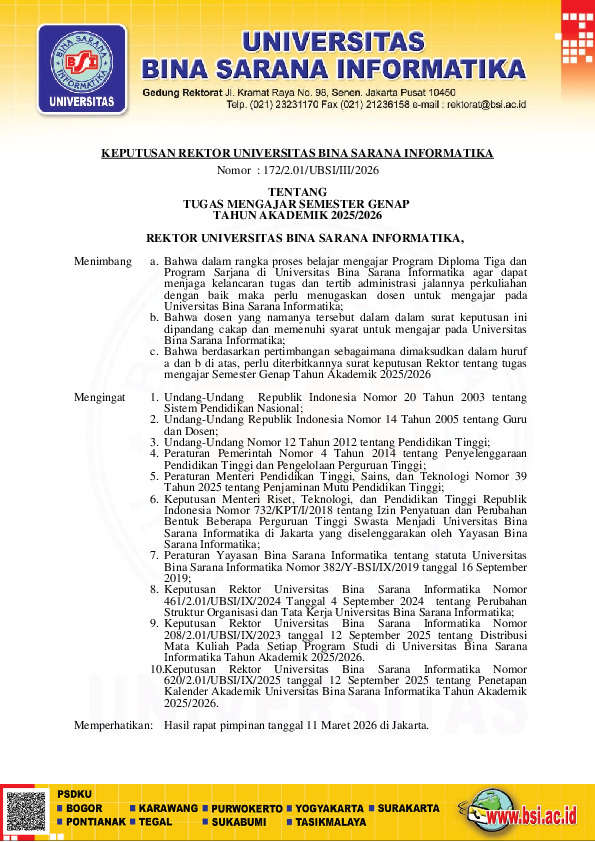
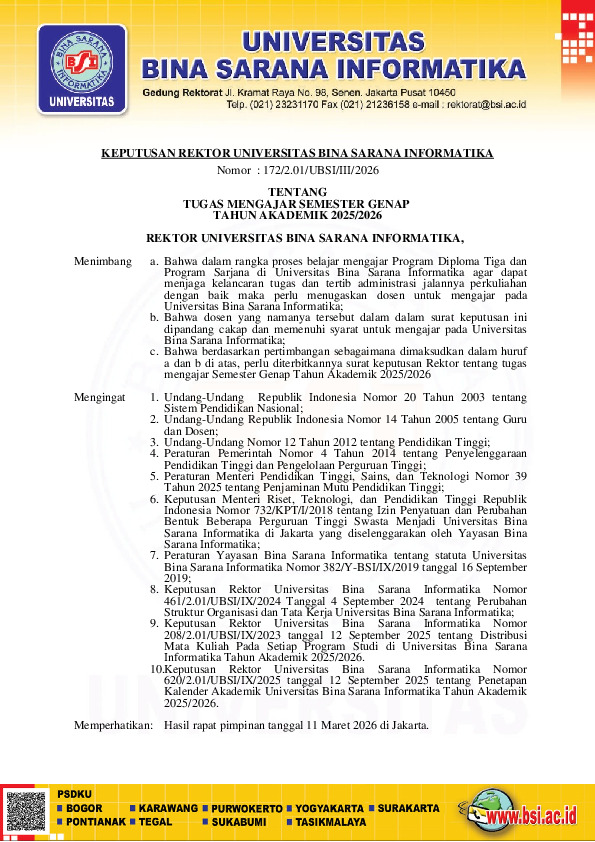
Surat Tugas Mengajar Genap 2025 2026
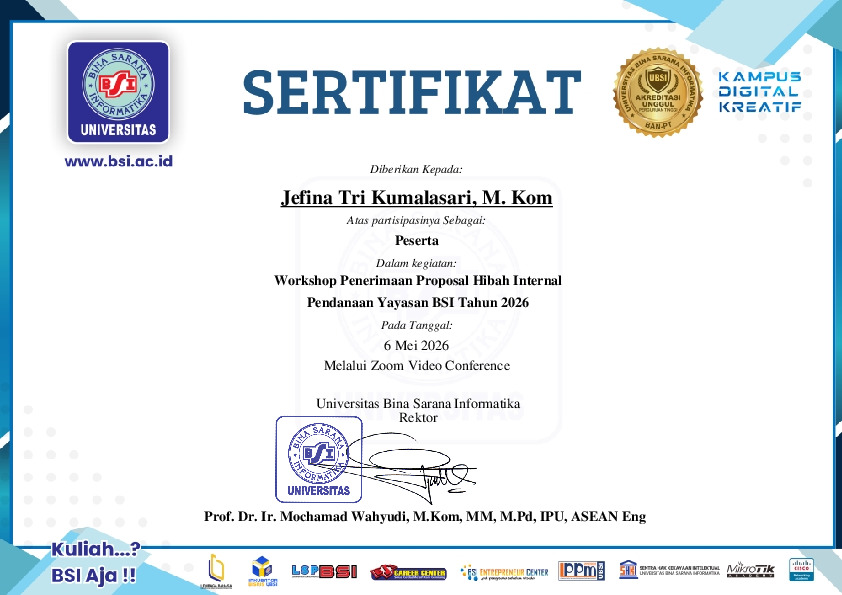
Sertifikat Hibah Yayasan BSI
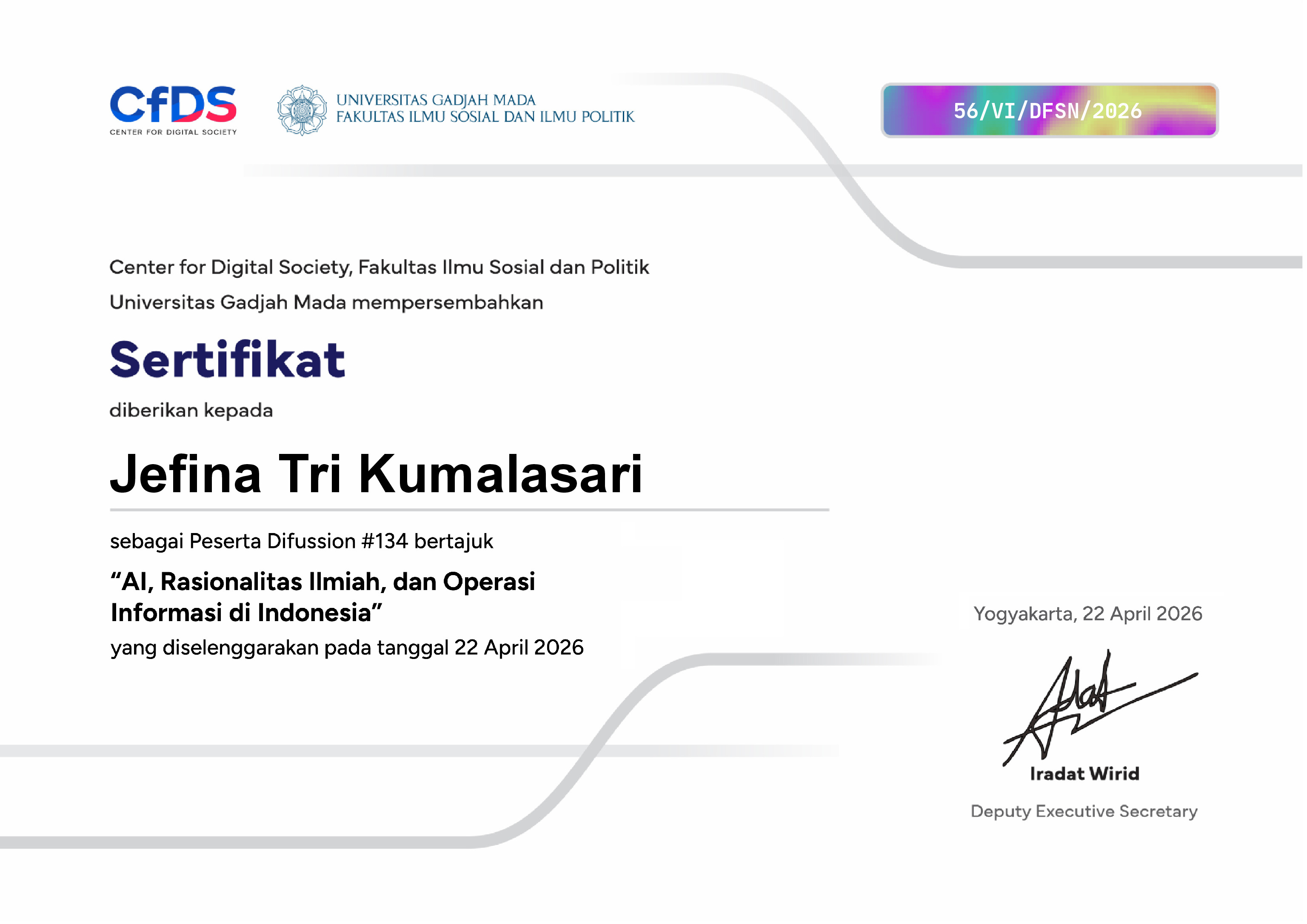
Sertifikat CFDF AI
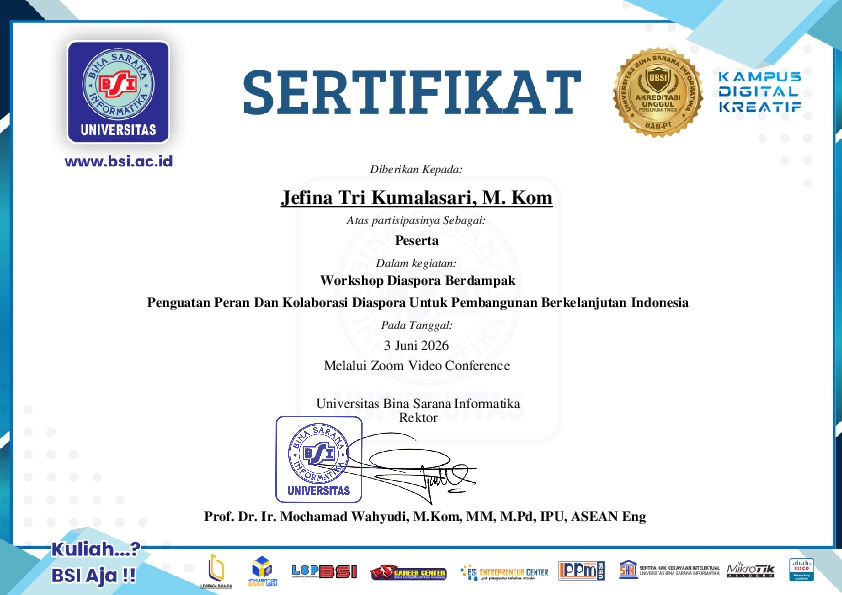
Sertifikat Diaspora
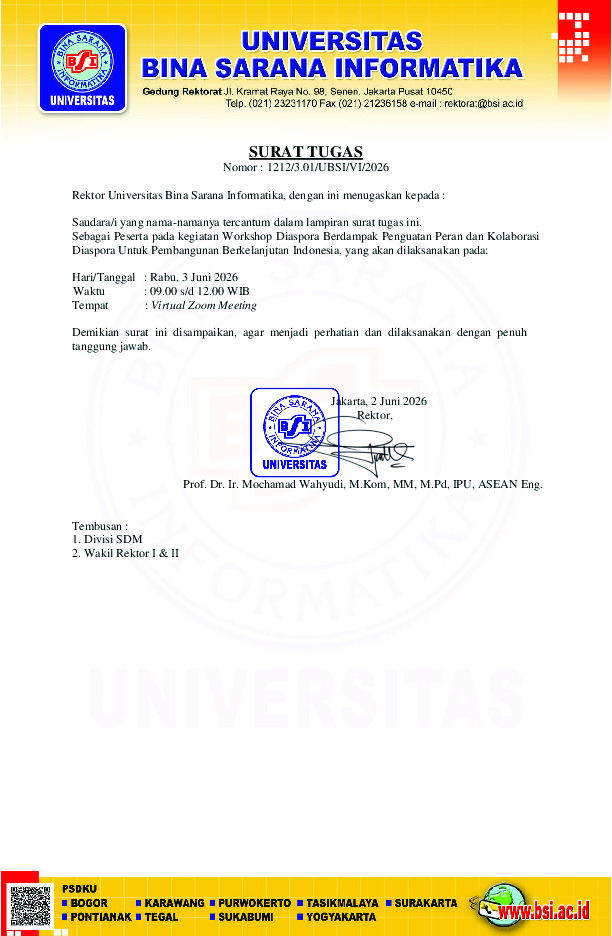
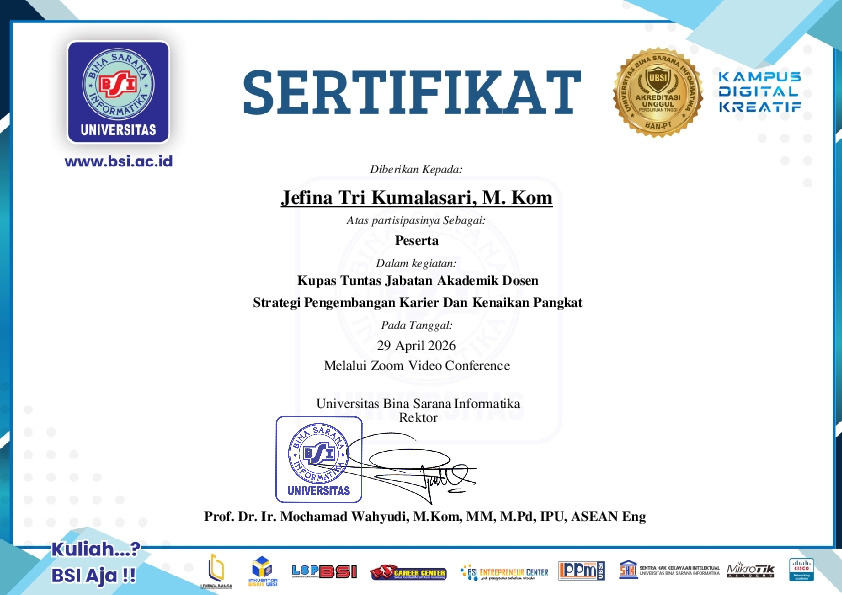
Sertifikat Kupas Tuntas Jabatan AKademik
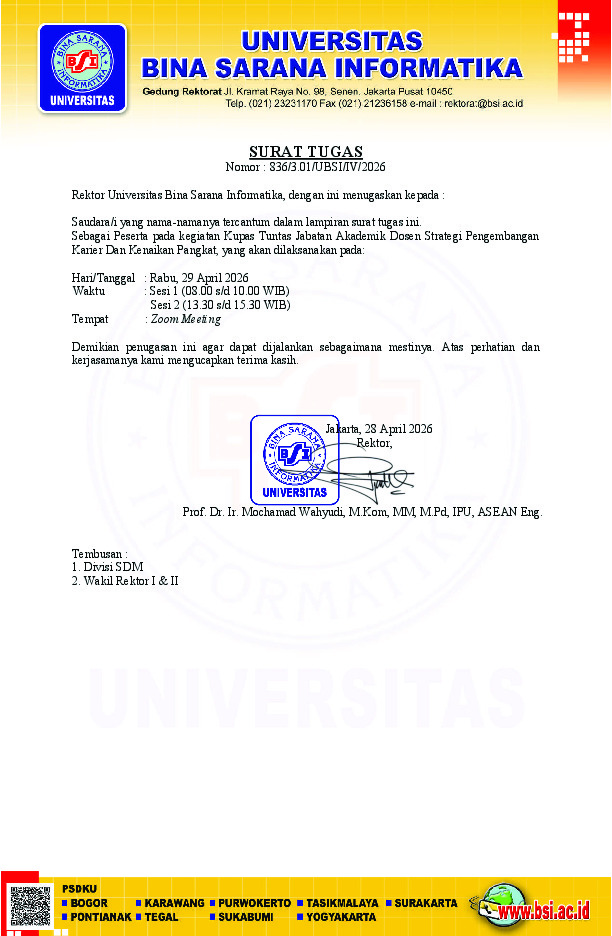
ST Kupas Tuntas Jabatan Akademik
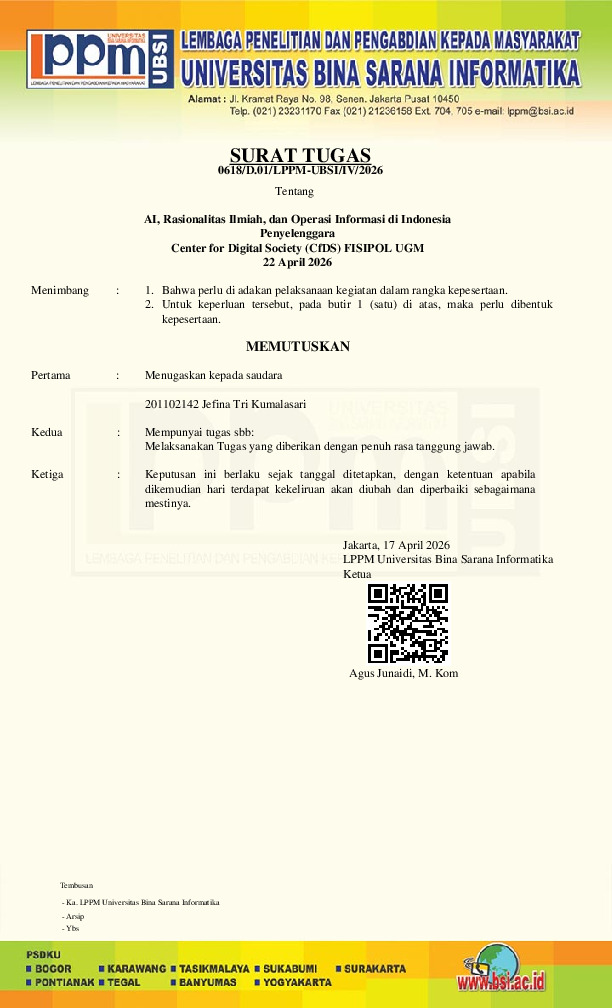
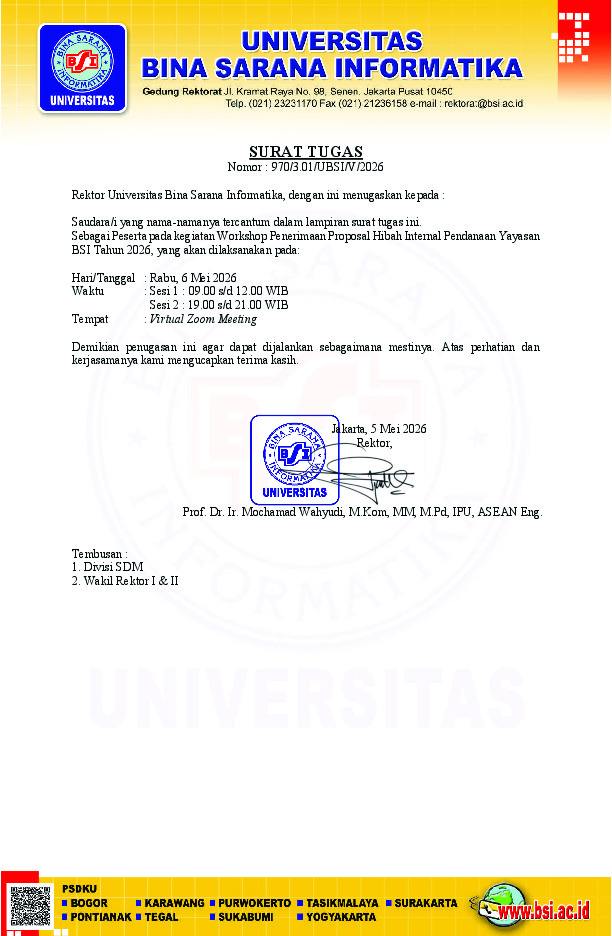
ST Peneriamaan Hibah BSI
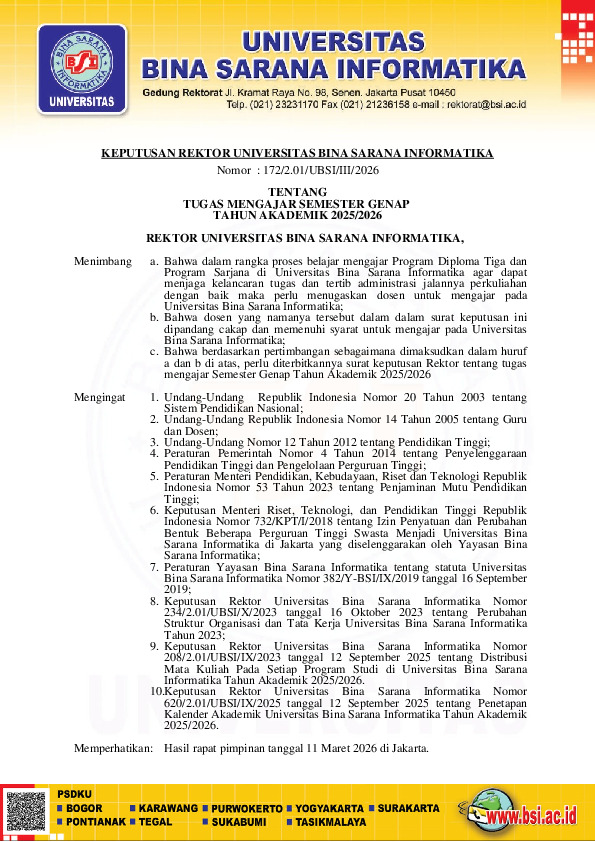
SK Mengajar Genap 2025 2026
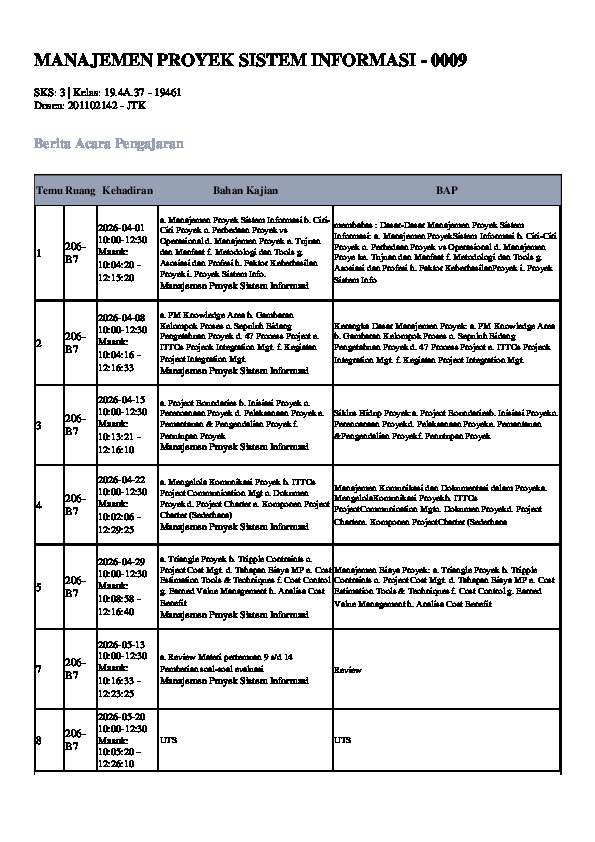
BAP MPSI (0009) 19.4A.37-19416
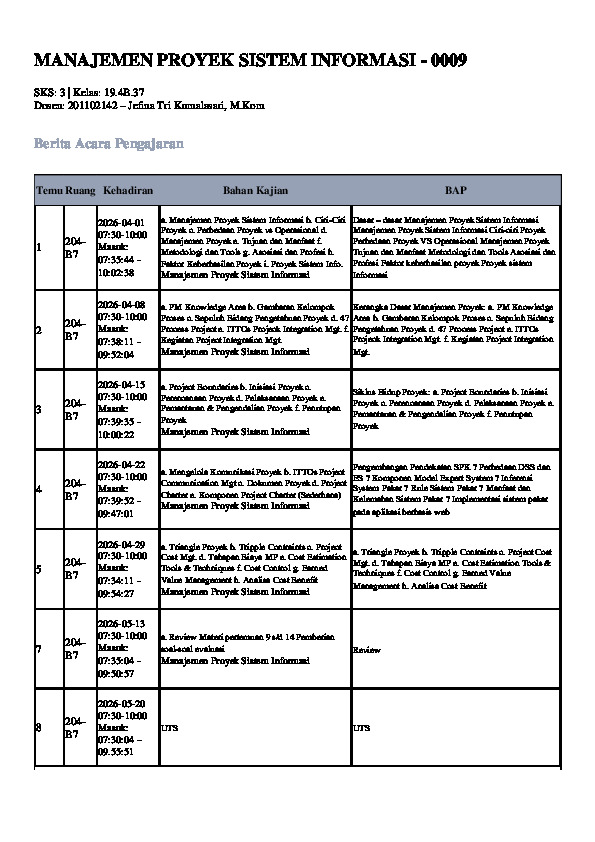
BAP MPSI (0009) 19.4B.37 -19426
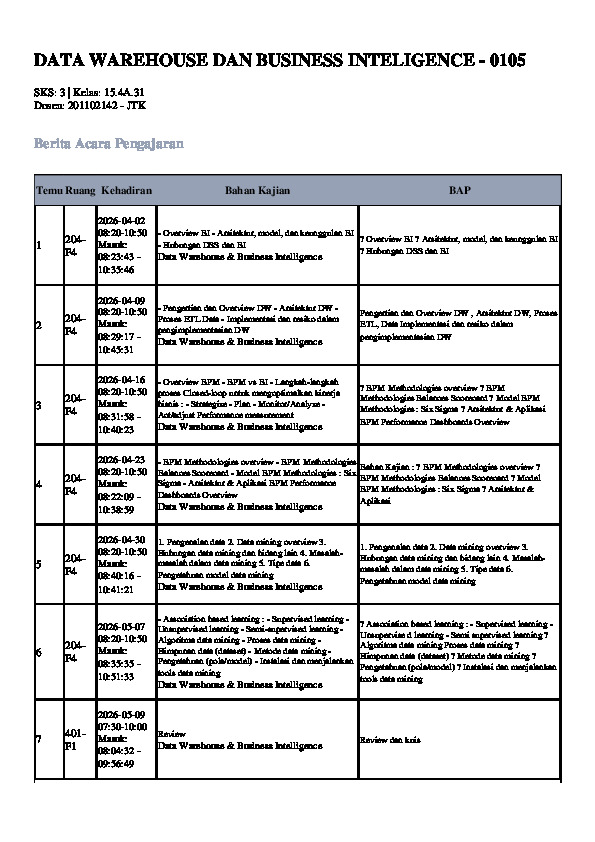
BAP Data Warehouse 15.4A.31
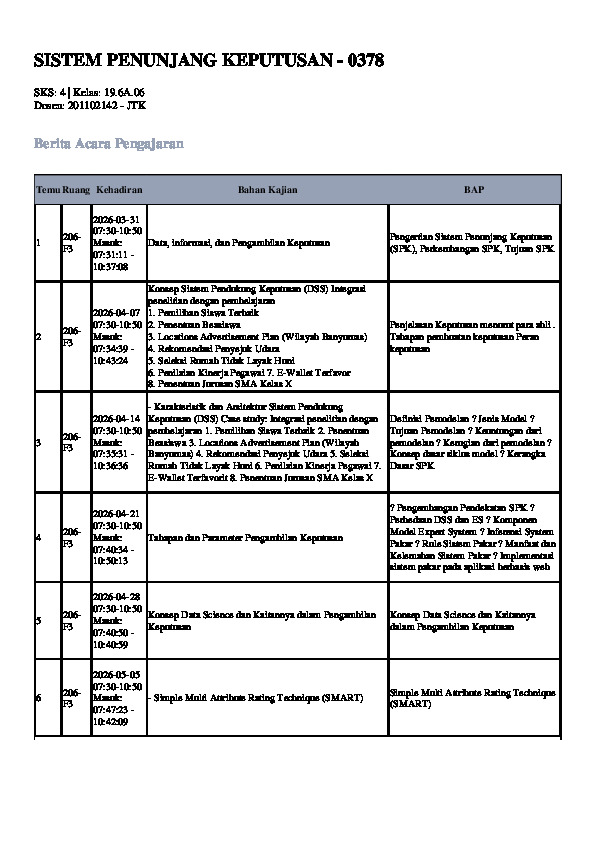
BAP SPK 19.6A.06
A. Z. Yonatan, “10 Negara dengan Mahasiswa Pengguna AI Tertinggi,” GoodStats.
R. Liu, “Data Analysis of Educational Evaluation Using K-Means Clustering Method,” Comput. Intell.
Neurosci., vol. 2022, 2022, doi: 10.1155/2022/3762431.
A. Pratama Putra, J. Tshivana, and E. Rilvani, “Kohesi: Jurnal Multidisiplin Saintek PERBANDINGAN
TEORITIS DAN EKSPERIMEN ALGORITMA K-MEANS DAN K-MEDOIDS DALAM
CLUSTERISASI DATA,” Aug. 2025, doi: https://doi.org/10.2238/0b2z5035.
B. Xu, M. Recker, X. Qi, N. Flann, and L. Ye, “Clustering Educational Digital Library Usage Data: A
Comparison of Latent Class Analysis and K-Means Algorithms,” 2013.
Y. Suprihartini, A. D. Rahayu, I. W. Karang, Suwarma, Marlina, and Irawan, “ANALISIS
PENGGUNAAN CHATBOT BERBASIS AI SEBAGAI ASISTEN VIRTUAL DALAM
PEMBELAJARAN DARING,” Jurnal Review Pendidikan dan Pengajaran, vol. 8, 2025, doi:
https://doi.org/10.61253/7n38s884.
I. T. Julianto, D. Kurniadi, M. R. Nashrulloh, A. Mulyani, and J. I. Komputer, “COMPARISON OF
CLASSIFICATION ALGORITHM AND FEATURE SELECTION IN BITCOIN
SENTIMENT ANALYSIS,” Jurnal Teknik Informatika (JUTIF), vol. 3, no. 3, 2022, doi:
10.20884/1.jutif.2022.3.3.343.
S. Russell and P. Norvig, “Artificial Intelligence A Modern Approach Third Edition,” 2010.
B. Dinata, D. Wulandari, N. Saputra, P. Juwita Kesuma, R. Putri Hasibuan, and M. Subhan, “Teknik
Penggunaan AI dalam Pembelajaran,” Journal of Contemporary Research, vol. 02, pp. 671
678, 2025, [Online]. Available: https://ziaresearch.or.id/index.php/fatih
S. Anwar, T. Suprapti, G. Dwilestari, I. Ali, P. Studi Rekayasa Perangkat Lunak Jln Perjuangan No,
and B. Kesambi Kota Cirebon, “PENGELOMPOKKAN HASIL BELAJAR SISWA DENGAN
METODE CLUSTERING K-MEANS Program Studi Sistem Informasi Jln Perjuangan No 10B
Kesambi Kota Cirebon 4),” Jurnal Sistem Informasi dan Teknologi Informasi), vol. 4, no. 2, pp.
60–72, 2022.
This is an Creative Commons License This work is licensed under a Creative
Commons Attribution-NonCommercial 4.0 International License.
628
Remik: Riset dan E-Jurnal Manajemen Informatika Komputer
Volume 10, Nomor 2, April 2026
http://doi.org/10.33395/remik.v10i2.16175
e-ISSN : 2541-1330
p-ISSN : 2541-1332
R. Hidayati, A. Zubair, A. Hidayat Pratama, L. Indana, P. Studi Sistem Informasi, and F. Teknologi
Informasi, “Analisis Silhouette Coefficient pada 6 Perhitungan Jarak K-Means Clustering
Silhouette Coefficient Analysis in 6 Measuring Distances of K-Means Clustering,” 2021.
Eda. Kavlakoglu and V. Winland, “What is k-means clustering? ,” https://www.ibm.com/id
id/think/topics/k-means-clustering.
M. A. Ramadhan, A. Gunawan, S. Lorenza, Z. Ainy, and M. Subhan, “Analisis Dampak Penggunaan
Artificial Intelligence Terhadap Kemampuan Berpikir Kritis Mahasiswa,” JURNAL
MUDABBIR (Journal Research and Education Studies), pp. 241–249, 2025, doi:
https://doi.org/10.56832/mudabbir.v5i2.1111.
C. Gomez, S. M. Cho, S. Ke, C. M. Huang, and M. Unberath, “Human-AI collaboration is not very
collaborative yet: a taxonomy of interaction patterns in AI-assisted decision making from a
systematic review,” 2024, Frontiers Media SA. doi: 10.3389/fcomp.2024.1521066.
Z. N. Khlaif, B. Hamamra, and E. T. Hussein, “AI Paradox in Higher Education: Understanding Over
Reliance, Its Impact, and Sustainable Integration,” Apr. 15, 2025. doi: 10.21203/rs.3.rs
6127885/v1.
P. B. Brandtzaeg and A. Følstad, “Why people use chatbots,” 2017. [Online]. Available:
https://botlist.co/
S. Broun, “AI can immediately boost worker productivity—but it comes at the cost of motivation and
makes employees bored with their jobs,” https://fortune.com/2025/06/03/ai-boost-worker
productivity-hurts-motivation-boredom/.