The documentary film Suster Apung tells the story of the struggle of a
nurse serving in a remote area of Indonesia. This film highlights the
dedication and sacrifice of medical personnel who face numerous
challenges in delivering healthcare services to underserved
communities. To effectively convey its message to the audience, a
documentary must be supported by a well-constructed screenplay. A
strong screenplay serves as a stimulus capable of eliciting immediate
emotional responses from viewers. The quality of a documentary's
screenplay can significantly enhance public empathy toward the
individuals and communities portrayed. This study aims to examine the
influence of the Suster Apung documentary’s screenplay on public
empathy, using a sample of 130 randomly selected respondents. The
research employs a quantitative approach with a descriptive-verificative
method, analyzed using multiple linear regression. The findings indicate
that cinematography, sound design, and the selection of interview
subjects contribute 30.2% to the development of empathy, while the
remaining 69.8% is influenced by other variables not examined in this
study. The results suggest that the quality of a documentary's screenplay
is shaped by effective cinematography, appropriate sound design, and
relevant sources. The better the screenplay quality, the higher the
potential for fostering audience empathy
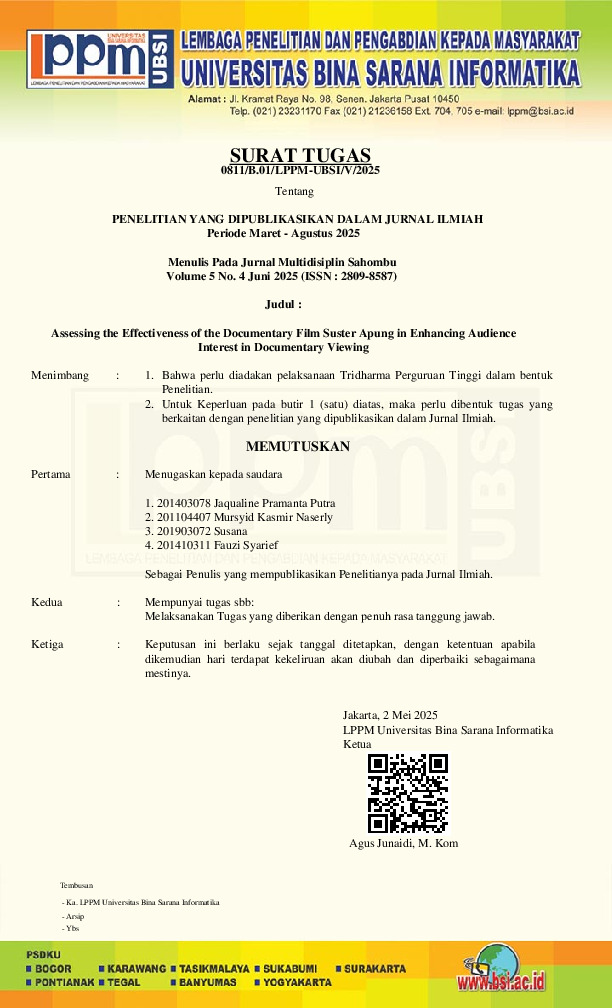
Surat Tugas Penelitian

Assessing the Effectiveness of the Documentary Film Suster Apung in Enhancing Audience Interest in Documentary Viewing
Ajidarma, S. G. (2000). Layar kata: Menengok 20 skenario pemenang Citra FFI 1973–1992.
Yogyakarta: Bintang Budaya.
Allo, L. M. S. (n.d.). Komunikasi antar pribadi. Bandung: PT Citra Aditya Bakti.
Arikunto, S. (2006). Prosedur penelitian: Suatu pendekatan praktik. Jakarta: Rineka Cipta.
Atmaja, S. G. (2000). Layar kita: Menengok 20 skenario pemenang Citra Festival Film
Indonesia 1973–1992. Yogyakarta: Bentang.
Danesi, M. (2002). Understanding media semiotics. London: Arnold Publishers.
Danesi, M. (2010). Pengantar memahami semiotika media. Yogyakarta: KDT.
Djamal, H. (2014). Seluk-beluk operasional stasiun penyiaran & produksi kreatif. Yogyakarta:
Adi Pustaka.
Effendi, O. U. (1990). Ilmu komunikasi: Teori dan praktik. Bandung: PT Remaja Rosdakarya.
Effendy, O. U. (1993). Ilmu, teori, dan filsafat komunikasi. Bandung: PT Citra Aditya Bakti.
Effendy, O. U. (2003). Ilmu, teori dan filsafat komunikasi. Bandung: Citra Aditya Bakti.
Effendy, O. U. (2007). Ilmu komunikasi: Teori dan praktik. Bandung: Remaja Rosdakarya.
Goleman, D. (2007). Kecerdasan emosional. Jakarta: PT Gramedia Pustaka Utama.
Imanto, T. (2007). Film sebagai proses kreatif dalam bahasa gambar. Jurnal Komunikologi,
Universitas Indonusa Esa Unggul, 4, 27–33.
Ioannidou, F., & Konstantikaki, V. (2008). Empathy and emotional intelligence: What is it really
about? International Journal of Caring Sciences, 1(3), 118–123.
Irwanto, et al. (2015). Produksi film dokumenter. Yogyakarta: Graha Cendekia.
Kusumawati, N., et al. (2015). Broadcasting televisi dan praktik. Yogyakarta: Graha Cendekia.
Liliweri, A. (2011). Komunikasi serba ada serba makna. Jakarta: Kencana.
MG, S. (2014). Empati: Perkembangan dan pentingnya dalam kehidupan bermasyarakat.
Universitas Tidar Magelang.
Morissan. (2015). Teori komunikasi individu hingga massa. Jakarta: PT Fajar Interpratama
Mandiri.
Notoatmodjo, S. (2010). Metodologi penelitian. Jakarta: Rineka Cipta.
Nugroho, S. (2014). Teknik dasar videografi. Yogyakarta: Penerbit Andi.
Nurudin. (2011). Pengantar komunikasi massa. Jakarta: PT Raja Grafindo Persada.
Pratista, H. (2008). Memahami film. Jakarta: Homerian Pustaka.
Rakhmat, J. (2002). Metode penelitian komunikasi. Bandung: PT Remaja Rosdakarya.
Rakhmat, J. (2005). Metode penelitian komunikasi. Bandung: Remaja Rosdakarya.
Riduwan, & Sunarto. (2010). Pengantar statistika: Untuk penelitian pendidikan, sosial,
ekonomi, komunikasi, dan bisnis. Bandung: Alfabeta.
Safaria, T. (2005). Interpersonal intelligence: Metode pengembangan kecerdasan
interpersonal anak. Yogyakarta: Amara Books.
Singarimbun, M., & Effendy, S. (1995). Metode penelitian survey. Jakarta: LP3ES.