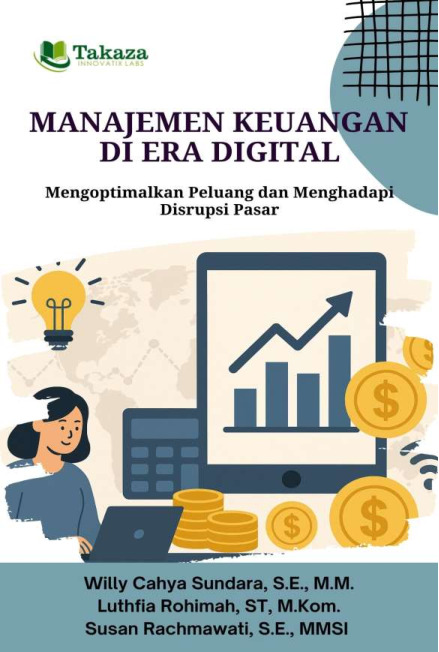
Era digital telah digunakan secara fundamental lanskap ekonomi dan strategi bisnis, termasuk dalam ranah manajemen keuangan. Transformasi teknologi seperti big data, kecerdasan buatan (AI), blockchaindan digital banking buykanhanya menghadirkan peluang besar, tetapi juga disrupsi yang signifikan terhadap praktik keuanfgan tradisional.
Buku ini mengulas bagaimana perusahaan dan individu dapat memanfaatkan teknologi digital untuk pengambilan keputusan finansial yang lebih cerdas, efisien dan adaptif. Selain itu buku ini juga menyosoti tantangan besar yang harus dihadapi seperti keamanan data, regulasi yang terus berkembang dan ancaman cybercrime terhadap sistem keuangan digital.
Buku Manajemen Keuangan
Abubakar, A. M., Elrehail, H., Alatailat, M. A., & Elçi, A. (2022). Knowledge management, decision-making style and organizational performance. Journal of Innovation & Knowledge, 7(1), 100185.
https://doi.org/10.1016/j.jik.2021.100185
Abubakar, A. M., Elrehail, H., Alatailat, M. A., & Elçi, A. (2022). Knowledge management, decision-making style and organizational performance. Journal of Innovation & Knowledge, 7(1), 100185.
https://doi.org/10.1016/j.jik.2021.100185
Alshaikh, M. M., Qureshi, M. R. N., & Al-Emran, M. (2023). A systematic review of security challenges in financial technology. Computers & Security, 128, 103178.
https://doi.org/10.1016/j.cose.2023.103178
Alsheibani, S., Cheung, Y., & Messom, C. (2020). Artificial intelligence adoption: A review of applications in financial decision-making. Journal of Risk and Financial Management, 13(7), 146. https://doi.org/10.3390/jrfm13070146
Appelbaum, D., Kogan, A., & Vasarhelyi, M. A. (2020). Big data and analytics in the modern audit engagement: Research needs. Auditing: A Journal of Practice & Theory, 39(1), 1–27. https://doi.org/10.2308/ajpt-52688
Arner, D. W., Zetzsche, D. A., Buckley, R. P., & Barberis, J. N. (2021). Sustainability, FinTech and financial inclusion. European Business Organization Law Review, 22(2), 297– 326. https://doi.org/10.1007/s40804-021-00213-6
Bada, A., Sasse, M. A., & Nurse, J. R. C. (2020). Cybersecurity awareness campaigns: Why do they fail to change behaviour? Communications of the ACM, 63(11), 62–70. https://doi.org/10.1145/3418290
Barredo Arrieta, A., Díaz-Rodríguez, N., & Del Ser, J. (2020). Explainable Artificial Intelligence (XAI): Concepts, taxonomies, opportunities and challenges toward responsible AI. Information Fusion, 58, 82–115. https://doi.org/10.1016/j.inffus.2019.12.012
Chen, H., Wang, Y., & Lu, Q. (2022). Blockchain scalability and its solutions: A survey. Future Generation Computer Systems, 126, 389–409. https://doi.org/10.1016/j.future.2021.07.005
Chen, M. A., Wu, Q., & Yang, B. (2022). How valuable is FinTech innovation? The Review of Financial Studies, 35(3), 1220– 1262. https://doi.org/10.1093/rfs/hhab084
Chen, T., Li, X., Luo, X., & Zhang, X. (2021). An overview of smart contract security: Issues, challenges, and solutions. IEEE Communications Surveys & Tutorials, 23(3), 1802–1833. https://doi.org/10.1109/COMST.2021.3070750
Demirgüç-Kunt, A., Klapper, L. F., Singer, D., & Ansar, S. (2021). The Global Findex Database 2021: Financial Inclusion, Digital Payments, and Resilience in the Age of COVID-19. World Bank. https://doi.org/10.1596/978-1-4648-1842-9
Dinh, T. T. A., Liu, R., & Chen, G. (2022). Untangling blockchain: A data processing view of blockchain systems. Proceedings of the VLDB Endowment, 15(2), 278–291. https://doi.org/10.14778/3484224.3484234
Feng, C., Li, Z., & Wang, D. (2023). Organizational readiness for big data analytics: An empirical investigation of financial firms. Information & Management, 60(1), 103707.
https://doi.org/10.1016/j.im.2022.103707
Floridi, L., Cowls, J., Beltrametti, M., & Chatila, R. (2022). AI4People—An ethical framework for a good AI society. Minds and Machines, 32(2), 245–268. https://doi.org/10.1007/s11023-021-09546-2
Ghosh, D., & Kumar, S. (2022). Big data analytics in financial decision making: Opportunities and challenges. Information Systems Frontiers, 24(3), 675–688. https://doi.org/10.1007/s10796-021-10131-y
Ghosh, S., Mallick, B., & Roy, S. (2023). Ethical implications of AI in financial decision-making: A stakeholder perspective. Journal of Business Ethics, 185, 455–472. https://doi.org/10.1007/s10551-022-05168-3
Gupta, A., Khandelwal, A., & Mittal, R. (2023). Data-driven finance: Opportunities and implications of financial analytics in the digital era. Technological Forecasting and Social Change, 190, 122349. https://doi.org/10.1016/j.techfore.2023.122349
Ionescu, L., & Ionescu, R. (2023). Regulatory Approaches for Digital Financial Markets: Risks and Policy Recommendations. Journal of Risk and Financial Management, 16(1), 45. https://doi.org/10.3390/jrfm16010045
Järvenpää, M. (2020). Digitalization of financial management in small firms: Challenges and opportunities. Journal of Accounting & Organizational Change, 16(3), 379–401. https://doi.org/10.1108/JAOC-12-2018-0126
Jobin, A., Ienca, M., & Vayena, E. (2022). The global landscape of AI ethics guidelines. Nature Machine Intelligence, 4(3), 210–221. https://doi.org/10.1038/s42256-022-00476-4
Kizil, C., & Ahmad, M. (2021). Cybersecurity and internal audit in digital finance systems. Journal of Financial Crime, 28(2), 456–470. https://doi.org/10.1108/JFC-07-2020-0120
Leoni, G., Bellucci, M., & Giommoni, L. (2023). Continuous learning in the digital age: The role of professional education in finance. Accounting Education, 32(1), 38–56. https://doi.org/10.1080/09639284.2022.2110001
Li, C., Fan, H., & Qiu, M. (2023). Advanced modeling of cyber risk exposure in banking: A machine learning approach. Journal of Banking & Finance, 144, 106726.
https://doi.org/10.1016/j.jbankfin.2023.106726
Liu, C., Zhang, R., & Huang, X. (2023). Data monetization strategy: From internal data analytics to external data trading. Information & Management, 60(2), 103719.
https://doi.org/10.1016/j.im.2022.103719
Luo, J., & Lin, S. (2023). Algorithmic trading and AI-driven financial systems: A performance evaluation. Expert Systems with Applications, 215, 119231.
https://doi.org/10.1016/j.eswa.2022.119231
Marston, C., Bonsón, E., & Escobar-Rodríguez, T. (2022). Enhancing financial transparency and corporate governance through digital reporting systems. Accounting, Auditing & Accountability Journal, 35(4), 902–926. https://doi.org/10.1108/AAAJ-06-2021-5256
Mehrotra, A., & McHenry, J. (2020). The evolution of hybrid financial systems: Challenges and opportunities. Global Finance Journal, 44, 100480.
https://doi.org/10.1016/j.gfj.2020.100480
Morley, J., Floridi, L., Kinsey, L., & Elhalal, A. (2021). From what to how: An initial review of publicly available AI ethics tools, methods and research to translate principles into practices. Science and Engineering Ethics, 27(1), 11.
https://doi.org/10.1007/s11948-020-00239-5
Nguyen, T. M., Tran, D., & Nguyen, H. N. (2021). AI model governance and validation in financial risk management. Journal of Risk and Financial Management, 14(12), 618. https://doi.org/10.3390/jrfm14120618
Nguyen, T., Pham, H., & Le, A. (2021). Real-time data in financial services: Enhancing customer experience and operational efficiency. Technovation, 108, 102332.
https://doi.org/10.1016/j.technovation.2021.102332
Ozili, P. K. (2023). Digital finance, financial inclusion and growth of informal businesses. Research in International Business and Finance, 65, 101798.
https://doi.org/10.1016/j.ribaf.2023.101798
Perera, S., Hoang, T., & Osei-Kyei, R. (2022). Blockchain technology in accounting and auditing: A critical literature review. Technological Forecasting and Social Change, 180, 121707. https://doi.org/10.1016/j.techfore.2022.121707
Rahman, M. A., & Widodo, T. (2021). Artificial intelligence in digital finance: A challenge to consumer literacy. Information Economics and Policy, 56, 100918.
https://doi.org/10.1016/j.infoecopol.2021.100918
Rahman, M. S., Islam, M. N., & Islam, S. (2023). Security vulnerabilities of blockchain and smart contract technology. Information Processing & Management, 60(1), 103145.
https://doi.org/10.1016/j.ipm.2022.103145
Raisch, S., & Krakowski, S. (2021). Artificial intelligence and management: The automation–augmentation paradox. Academy of Management Review, 46(1), 192–210. https://doi.org/10.5465/amr.2018.0072
Rozario, A. M., & Thomas, C. (2020). Reengineering the audit with blockchain and smart contracts. Accounting Horizons, 34(3), 1–18. https://doi.org/10.2308/acch-52602
Saleh, F. (2021). Blockchain without waste: Proof-of-stake. Review of Financial Studies, 34(3), 1156–1190. https://doi.org/10.1093/rfs/hhaa075
Sari, A., & Fauzan, M. (2023). Toward inclusive financial behavior: The role of digital financial literacy and consumer protection. International Journal of Consumer Studies, 47(4), 812–825. https://doi.org/10.1111/ijcs.12851
Saura, J. R., Palos-Sanchez, P., & Correia, M. B. (2021). Digital marketing and privacy: Big data challenges in the financial sector. Journal of Innovation & Knowledge, 6(2), 98–105. https://doi.org/10.1016/j.jik.2020.08.001
Savelyev, A. (2022). Contract law 2.0: ‗Smart‘ contracts as the beginning of the end of classic contract law. Computer Law & Security Review, 44, 105649.
https://doi.org/10.1016/j.clsr.2021.105649
Shabsigh, G., Tiwari, S., & Sharma, S. (2023). Regulating the new frontier: Governance challenges in the digital financial ecosystem. Journal of Financial Regulation and Compliance, 31(2), 154–170.
https://doi.org/10.1108/JFRC-08-2022-0092
Shao, Z., Liu, X., & Chen, Y. (2022). From data governance to data value: Examining the role of digital capabilities. Information Systems Journal, 32(1), 93120. https://doi.org/10.1111/isj.12309
Singh, A., Wang, Y., & Karim, M. F. (2022). Cross-border payments and the impact of fintech: A developing country perspective. Technological Forecasting and Social Change, 174, 121217.
https://doi.org/10.1016/j.techfore.2021.121217
Véliz, C. (2023). Algorithmic injustice: How algorithms can promote unfairness and what to do about it. Philosophy & Technology, 36(1), 1–24. https://doi.org/10.1007/s13347-022-00590-w
Wamba-Taguimdje, S.-L., Fosso Wamba, S., Kala Kamdjoug, J. R., & Tchatchouang Wanko, C. E. (2020). Influence of big data analytics capabilities on firm performance: The mediating role of dynamic capabilities. Journal of Business Research, 112, 193–203.
https://doi.org/10.1016/j.jbusres.2020.03.019
Wulandari, M., Taufik, R., & Santoso, B. (2023). E-reputation and customer trust: Exploring the fintech user behavior in Southeast Asia. Technological Forecasting and Social Change, 186, 122122.
https://doi.org/10.1016/j.techfore.2022.122122
Zhang, L., Ma, J., & Yang, X. (2023). Credit scoring using gradient boosting techniques: A comparison with logistic regression. Journal of Computational Finance, 27(1), 55–78. https://doi.org/10.21314/JCF.2023.441
Zhou, Y., Li, C., & Sun, T. (2022). Unsupervised learning for financial fraud detection using clustering methods. Computers & Security, 112, 102535.