Reading is a fundamental skill that must be mastered in learning English as foreign language. There are many factors which can influence students’ reading comprehension. This study aims to examine the effects of perception on school environment and vocabulary mastery towards students’ reading comprehension in the State of Senior High School in Tangerang Banten. Population in this research is 11th grade students of State Senior High School in Kota Tangerang Banten. The samples of the research were taken as much as 60 respondents from two schools of one sub-district with A accredited. The data were collected by giving two sets of objective test and one set of questionnaire as the instruments to the 60 students. The results showed that 1) there is positive effect of perception on school environment and vocabulary mastery simultaneously towards students’ reading comprehension; 2) there is positive effect of perception on school environment towards students’ reading comprehension; 3) there is positive effect of vocabulary mastery towards students’ reading comprehension.
SURAT TUGAS JOURNAL
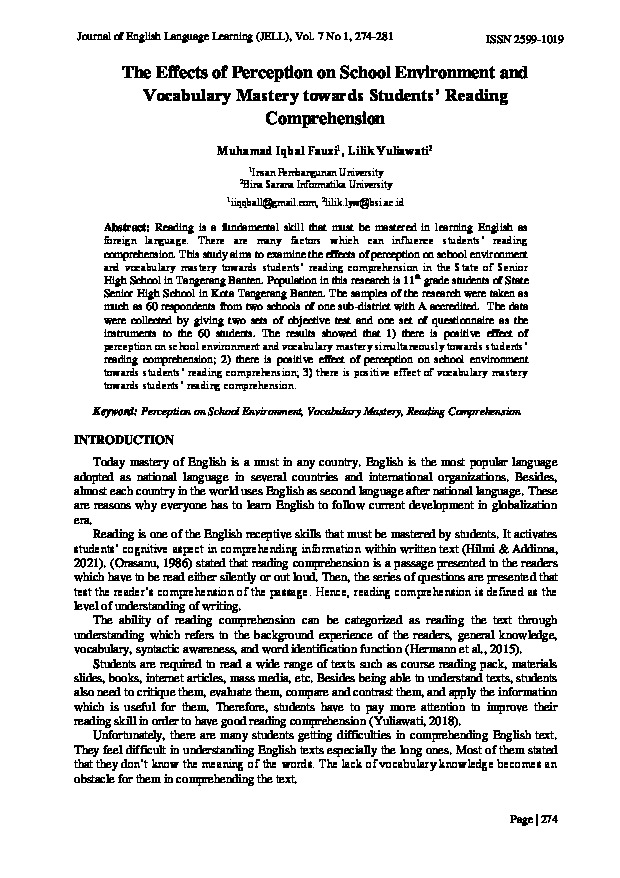
File Journal
Abdullah, S., & Mukadar, S. (2023). The Correlation between Students’ Vocabulary Mastery and Reading Comprehension at the Second Grade of SMA Negeri 10 Kota Ternate. EDUCATUM Scientific Journal of Education, 1(1), 13–19.
Burns, P. C., & Broman, B. L. (1975). The Language Arts in Childhood Education (third edit). Chicago: Rand McNally College Publishing Co.
Diamanduros, T., & Downs, E. (2011). Creating a Safe School Environment: How to Prevent Cyberbullying at Your School. Library Media Connection, 30(2), 36–38.
Dong, Y., Hu, J., Wu, X., Zheng, H., & Peng, X. (2018). The Evidence of Different Learning Environment Learning Effects on Vocabulary Size and Reading Comprehension. Frontiers in Psychology, 9(1914), 1–11. https://doi.org/10.3389/fpsyg.2018.01914
Fasikh, M. (2018). The Effect of Vocabulary Mastery toward The Reading Comprehension Skill for the Students Grade VIII in the State of Junior High School in Bekasi District. Journal of English Language and Literature (JELL), 3(1), 69–86.
Floris, F. D., & Divina, M. (2009). A Study on the Reading Skills of EFL University Students. TEFLIN Journal, 20(1), 37–47.
García-castro, V. (2020). The Effects of Vocabulary Knowledge in L2 Semantic Lexical Engagement: The Case of Adult Learners of English as a Second Language. Indonesian Journal of Applied Linguistics, 10(1), 261–270.
Gilakjani, A. P., & Sabouri, N. B. (2016). A Study of Factors Affecting EFL Learners’ Reading Comprehension Skill and the Strategies for Improvement. International Journal of English Linguistics, 6(5), 180–187. https://doi.org/10.5539/ijel.v6n5p180
Harinarayanan, S., & Pazhanivelu, G. (2018). Impact of School Environment on Academic Achievement of Secondary School Students at Vellore Educational District. International Journal of Education, 7(1), 13–19.
Hayati, A. (2016). The Correlation between Indonesian Students ’ Vocabulary Mastery and Their Reading Comprehension. AL-TA’LIM JOURNAL, 23(2), 95–99.
Hermann, K. M., Kocisky, T., Grefenstette, E., Espeholt, L., Kay, W., Suleyman, M., & Blunsom, P. (2015). Teaching Machines to Read and Comprehend. In Advances in Neural Information Processing System (NIPS).
Hilmi, L., & Addinna, A. (2021). The Effectiveness of Reading to Tell the Story to Students ’ Reading Comprehension Reviewed from Autonomy Level. In Advances in Social Science, Education and Humanities Research (Vol. 579, pp. 161–165). Atlantis Press SARL.
Hornby, A. S. (1995). Oxford Advanced Learner’s Dictionary of Current English. (J. Crowther, Ed.). New York: Oxford University Press.
Ismawati, K., & Syafryadin. (2022). Students’ Perceptions of Using Readtheory.org in Reading Comprehension. Journal of Applied Linguistics and Literacy, 6(2), 171–180.
Lawrence, A. S. A., & Vimala, A. (2012). School Environment and Academic Achievement of Standard IX Students. Journal of Educational and Instructional Studies in the World, 2(3), 210–215.
Lehr, F., Osborn, J., & Hiebert, E. H. (2004). A Focus on Vocabulary. In Research-Based Practices in Early Reading Series. the Regional Educational Laboratory at Pacific Resources for Education and Learning.
Moghadam, S. H., Zainal, Z., & Ghaderpour, M. (2012). A Review on the Important Role of Vocabulary Knowledge in Reading Comprehension Performance. In The 8th International Language for Specific Purposes (LSP) Seminar - Aligning Theoretical Knowledge with Professional Practice (Vol. 66, pp. 555–563). Johor: Procedia - Social and Behavioral Sciences. https://doi.org/10.1016/j.sbspro.2012.11.300
Mokalu, R. E., Muntuuntu, M., & Tuna, J. R. (2021). Students’ Perception about the Effect of School Library in Their Reading Comprehension Achievement. Jurnal Ilmiah Bahasa & Seni, 1(5), 505–514.
Nanda, D. W., & Azmy, K. (2020). Poor Reading Comprehension Issue in EFL Classroom among Indonesian Secondary School Students: Scrutinizing the Causes , Impacts and Possible Solutions. Englisia: Journal of Language, Education, and Humanities, 8(1), 12–24. https://doi.org/10.22373/ej.v8i1.6771
Orasanu, J. (1986). Reading Comprehension: From Research to Practice. New Jersey: Lawrence Erlbaum Associates Publisher.
Sasmoko. (2004). Metode Penelitian. Jakarta: UKI Press.
Sevilla, C. G., Ochave, J. A., Punsalan, T. G., Regala, B. P., & Uriarte, G. B. (2006). Pengantar Metode Penelitian. Jakarta: Universitas Indonesia Press.
Sugiyono. (2013). Metode Penelitian Pendidikan Pendekatan Kuantitatif, Kualitatif, dan R&D. Bandung: Alfabeta.
Sutarsyah, C. (2008). Vocabulary Constraint on Reading Materials. Jurnal Ilmu Pendidikan, 15(3), 193–200.
Tarigan, H. G. (1986). Pintar Berbahasa Inggris. Malang: Pustaka Hidayah.
Tentama, F., & Jayanti, H. D. (2019). Self-Concept , Perception of the Learning Environment and Employability: A Study of Vocational High School Students in Prambanan Yogyakarta, Indonesia. Humanities & Social Sciences Reviews, 7(1), 433–440.
Vaatstra, R., & Ries, R. . (2007). The Effect of the Learning Environment on Competences and Training for Workplace According to Graduates. Higher Education, 53(3), 335–357.
Wang, M.-T., & Holcombe, R. (2010). No Title. American Educational Research Journal, 47(3), 633–662.
Wayne, S. J., Fortner, S. A., Kitzes, J. A., Timm, C., & KalishmanSummers. (2013). Cause or effect? The relationship between student perception of the medical school learning environment and academic performance on USMLE Step 1. Medical Teacher, 35(5), 376–380.
Wingard, A. K., Hermawan, H. D., & Dewi, V. R. (2020). The Effects of Students’ Perception of the School Environment and Students’ Enjoyment in Reading towards Reading Achievement of 4th Grades Students in Hong Kong. Indonesian Journal on Learning and Advanced Education, 2(2), 68–74. https://doi.org/10.23917/ijolae.v2i2.9350
Yuliawati, L. (2018). The Effects of Grammar and Vocabulary Mastery on Students ’ Reading Comprehension. Wanastra.