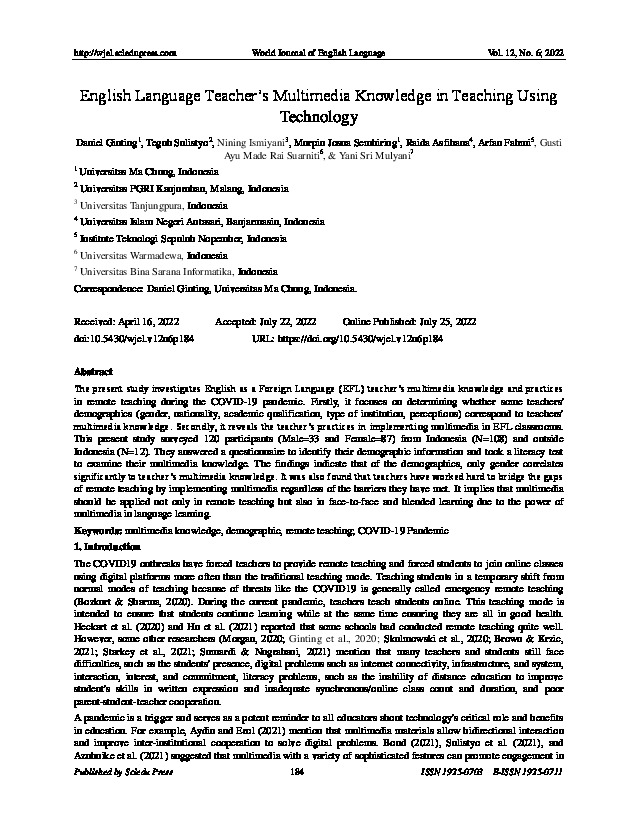
The present study investigates English as a Foreign Language (EFL) teacher’s multimedia knowledge and practices
in remote teaching during the COVID-19 pandemic. Firstly, it focuses on determining whether some teachers'
demographics (gender, nationality, academic qualification, type of institution, perceptions) correspond to teachers'
multimedia knowledge. Secondly, it reveals the teacher’s practices in implementing multimedia in EFL classrooms.
This present study surveyed 120 participants (Male=33 and Female=87) from Indonesia (N=108) and outside
Indonesia (N=12). They answered a questionnaire to identify their demographic information and took a literacy test
to examine their multimedia knowledge. The findings indicate that of the demographics, only gender correlates
significantly to teacher’s multimedia knowledge. It was also found that teachers have worked hard to bridge the gaps
of remote teaching by implementing multimedia regardless of the barriers they have met. It implies that multimedia
should be applied not only in remote teaching but also in face-to-face and blended learning due to the power of
multimedia in language learning.
CEK Plagiat Artikel Jurnal "English Language Teacher’s Multimedia Knowledge in Teaching Using Technology
BUkti Review Artikel Jurnal
ST Artikel Jurnal
Artikel Jurnal "English Language Teacher’s Multimedia Knowledge in Teaching Using Technology
Al-swalha, A. S. M., & Suliman, A. (2017). Training needs of faculty members in Al-Huson College for employing
multimedia in teaching. Journal of Education and Practice, 8(12), 102-111. Retrieved from
http://ezproxy.lib.uconn.edu/login?url=https://search.ebscohost.com/login.aspx?direct=true&db=eric&AN=EJ1
140620&site=ehost-live
Altawallbeh, M., Thiam, W., Alshourah, S., & Fong, S. F. (2015). Do the instructors differ in their behavioral
intention to adopt e-learning based on age, gender, and internet experience? Journal of Education and Practice,
6(18), 41–50. http://search.ebscohost.com/login.aspx?direct=true&db=eric&AN=EJ1079742&site=ehost-live
Anderson, J. R., & Bower, G. (1983). Human associative memory. Washington, DC: Winston.
Arrow, A. W., & Finch, B. T. (2013). Multimedia literacy practices in beginning classrooms and at home: The
differences in practices and beliefs. Literacy, 47(3), 131-141. https://doi.org/10.1111/lit.12006
Aydin, E., & Erol, S. (2021). The views of Turkish language teachers on distance education and digital literacy
during the COVID-19 pandemic. International Journal of Education and Literacy Studies, 9(1), 60.
https://doi.org/10.7575/aiac.ijels.v.9n.1p.60
Azubuike, O. B., Adegboye, O., & Quadri, H. (2021). Who gets to learn in a pandemic? Exploring the digital divide
in remote learning during the COVID-19 pandemic in Nigeria. International Journal of Educational Research
Open, 2–2(October 2020), 100022. https://doi.org/10.1016/j.ijedro.2020.100022
Blevins, B. (2018). Teaching digital literacy composing concepts: Focusing on the layers of augmented reality in an
era of changing technology. Computers and Composition, 50, 21-38.
https://doi.org/10.1016/j.compcom.2018.07.003
Bond, M. (2021). Schools and emergency remote education during the COVID-19 pandemic: A living rapid
systematic review. Asian Journal of Distance Education, 15(2), 191-247.
https://doi.org/10.5281/zenodo.4425683
Bozkurt, A., & Sharma, R. C. (2020). Emergency remote teaching in a time of global crisis due to the CoronaVirus
pandemic. Asian journal of distance education, 15(1), i-vi.
Brown, S., & Krzic, M. (2021). Lessons learned teaching during the COVID-19 pandemic: Incorporating change for
future large science courses. https://doi.org/10.1002/nse2.20047
Cai, H. (2012). E-learning and English teaching. IERI Procedia, 2, 841-846.
https://doi.org/10.1016/j.ieri.2012.06.180
Çetin, E. (2021). Digital storytelling in teacher education and its effect on the digital literacy of pre-service teachers.
Thinking Skills and Creativity, 39, 100760. https://doi.org/10.1016/j.tsc.2020.100760
Chandler, P., & Sweller, J. (1991). Cognitive load theory and the format of instruction. Cognition and Instruction,
8(1), 293-332. https://doi.org/10.1207/s1532690xci0804_2
Chi, M. T., Glaser, R., & Rees, E. (1982). Expertise in problem-solving. In R. Sternberg, Advances in the psychology
of human intelligence (pp. 7-76). Hillsdale, NJ: Erlbaum.
de Jong, T. (2010). Cognitive load theory, educational research, and instructional design: some food for thought.
Instructional Science, 38(2), 105-134. https://doi.org/10.1007/s11251-009-9110-0
Dijkema, S., Doolaard, S., Ritzema, E. S., & Bosker, R. J. (2019). Ready for take-off? The relation between teaching
behavior and teaching experience of Dutch beginning primary school teachers with different educational
backgrounds. Teaching and Teacher Education, 86, 102914. https://doi.org/10.1016/j.tate.2019.102914
Egan, D. E., & Schwartz, B. J. (1979). Chunking in recall of symbolic drawings. Memory & Cognition, 7(1),
149-158. https://doi.org/10.3758/BF03197595
Ginting, D., Djiwandono, P. I., Woods, R., & Lee, D. (2020). Is autonomous learning possible for Asian students?
The story of a mooc from Indonesia. Teaching English with Technology, 20(1), 60-79.
Ginting, D., Fahmi, Utimadini, N. J., Barella, Y., & Khatimah, H. (2022). The Interplay of motivation and
quality of instructions in the self-paced program: a MOOC for administration staffs, World Journal of
English Language, 12(1), 198-210. https://doi.org/10.5430/wjel.v12n1p198
Ginting, D., Fahmi., Barella, Y., Linarsih, A., & Hamdani, B. (2021). Foreign language students' voices on
blended learning and fully online classes during the COVID-19 pandemic. World Journal of English
Language, 11(2), 62-70. https://doi.org/10.5430/wjel.v11n2p62
Ginting, D., Woods, R., Nuswantara, K., Sukaton, O. Z., & Jiuangga, V. V. (2021). Teachers voice: their
experiences in emergency remote teaching amid Covid-19 pandemic. Mextesol Journal, 45(4), 1-15
Gonzalez-Frey, S., Garas-York, K., Kindzierski, C., & Henry, J. (2021). College students' attitudes towards remote
instruction during the coronavirus pandemic: Future directions. Excelsior: Leadership in Teaching and Learning,
13(2), 96-112. https://doi.org/10.14305/jn.19440413.2021.13.2.02
Gürkan, S. (2019). Effect of annotation preferences of the EFL students on their level of vocabulary recall and
retention. Journal of Educational Computing Research, 57(6), 15-30
https://doi.org/10.1177/0735633118796843
Halim, M. S. A. A., & Hashim, H. (2019). Integrating web 2.0 technology in ESL classroom: A review on the
benefits and barriers. Journal of Counselling and Educational Technology, 2(2), 19-26.
https://doi.org/10.32698/0421
Hamzah, M. I., Rinaldi, & Razak, K. A. (2014). Multimedia usage among Islamic education lecturers at higher
education institutions. International Education Studies, 7(13), 157-165. https://doi.org/10.5539/ies.v7n13p157
Harp, S. F., & Mayer, R. E. (1998). How seductive details do their damage: A theory of cognitive interest in science
learning. Journal of Educational Psychology, 90(1), 414-434. https://doi.org/10.1037/0022-0663.90.3.414
Heckart, K., Seitz, Z., Reiter, J., Ingold, J., Francis, A., & Hitchcock, C. (2020). Teaching remotely during the
Coronavirus pandemic Social Education Staff. Journal Social Education, 84(3), 146-151.
Hina, Q. A., Chaudhary, A. Q., & Nudrat, S. (2017). Impact of gender, qualification, and experience on mentoring
practices in public sector Universities of Islamabad. Bulletin of Education and Research, 39(3), 183-201.
Hu, X., Chiu, M. M., Leung, W. M. V., & Yelland, N. (2021). Technology integration for young children during
COVID‐19: Towards future online teaching. British Journal of Educational Technology, November 2020, 1-25.
https://doi.org/10.1111/bjet.13106
Jozwik, S. L., Freeman-Green, S., Kaczorowski, T. L., & Douglas, K. H. (2021). Effects of peer-assisted multimedia
vocabulary instruction for high school English language learners. Reading and Writing Quarterly, 37(1), 82-100.
https://doi.org/10.1080/10573569.2020.1723153
Kalyuga, S. (2009). Managing cognitive load in adaptive multimedia learning. New York, NY: Information Science Reference. https://doi.org/10.4018/978-1-60566-048-6
Kalyuga, S. (2014). The expertise reversal principle in multimedia learning. In R. E. Mayer (Ed.), Cambridge
handbooks in psychology. In R. Mayer, The Cambridge handbook of multimedia learning (pp. 576-597). Oxford:
Cambridge University Press. Doi: https://doi.org/10.1017/CBO9781139547369.028
Kalyuga, S., Ayres, P., Chandler, P., & Sweller, J. (2003). Expertise reversal effect. Educational Psychologist, 38(1),
23-31. https://doi.org/10.1207/S15326985EP3801_4
Kalyuga, S., Chandler, P., & Sweller, J. (1998). Levels of expertise and instructional design. Human Factors. 40(1),
1-17. https://doi.org/10.1518/001872098779480587
Kalyuga, S., Chandler, P., & Sweller, J. (1999). Managing split-attention and redundancy in multimedia instruction.
Applied Cognitive Psychology, 13(1), 351-357.
https://doi.org/10.1002/(SICI)1099-0720(199908)13:4<351::AID-ACP589>3.0.CO;2-6
Karipi, E. (2019). Experiences of the Namibian College of open learning tutors in using multimedia resources in
distance education. African Educational Research Journal, 7(1), 14-21. https://doi.org/10.30918/aerj.71.18.092
Koedinger, K. R., & Aleven, V. (2007). Exploring the assistance dilemma in experiments with cognitive tutors.
Educational Psychology Review, 19(1), 239-264. https://doi.org/10.1007/s10648-007-9049-0
Kranthi, K. (2017). Technology-enhanced language learning (TELL). International Journal of Business and
Management Invention ISSN (Online, 6) (2), 2319-8028.
Li, G. (2017). From absence to affordances: Integrating old and new literacies in school-based instruction for English
learners. Journal of Adolescent and Adult Literacy, 61(3), 241-246. https://doi.org/10.1002/jaal.662
Li, G., & Ni, X. (2011). Primary EFL teachers' technology use in China: Patterns and perceptions. RELC Journal,
42(1), 69-85. https://doi.org/10.1177/0033688210390783
Lin C., J., Wang, H., Li, T., & Huang, L. (2007). Reliability and validity of nurse's job satisfaction scale and nurse's
professional commitment. Mid Taiwan J Med, 12(1), 65-75.
Luthfiyyah, R., Hafifah, G. N., Ivone, F. M., & Tresnadewi, S. (2021). Technology use in secondary level of English
language teaching: A literature review. JEES (Journal of English Educators Society), 6(1), 79-89.
https://doi.org/10.21070/jees.v6i1.1020
Mantiri, F. (2014). Multimedia and technology in learning. Universal Journal of Educational Research, 2(9),
589-592. https://doi.org/10.13189/ujer.2020.081278
Mautone, P. D., & Mayer, R. E. (2001). Signalling as a cognitive guide in multimedia learning. Journal of
Educational Psychology, 93(1), 377-389. https://doi.org/10.1037/0022-0663.93.2.377
Mayer, R. E. (1997). Multimedia learning: Are we asking the right questions? Educational Psychologist, 32(1), 1-19.
https://doi.org/10.1207/s15326985ep3201_1
Mayer, R. E. (2001). Multimedia learning. New York, NY: Cambridge University Press.
https://doi.org/10.1017/CBO9781139164603
Mayer, R. E., & Moreno, R. (2003). Nine ways to reduce cognitive load in multimedia learning. Educational
Psychologist, 38(1), 43-52. https://doi.org/10.1207/S15326985EP3801_6
McNamara, D., Kintsch, E., Songer, N. B., & Kintsch, W. (1996). Are good texts always better? Interactions of text
coherence, background knowledge, and levels of understanding in learning from text. Cognition and Instruction,
14(1), 1-43. https://doi.org/10.1207/s1532690xci1401_1
Mojica, C. P., & Castañeda-Peña, H. (2017). A learning experience of the gender perspective in English teaching
contexts. PROFILE Issues in Teachers' Professional Development, 19(1), 139.
https://doi.org/10.15446/profile.v19n1.56209
Moreno, R. (2002). Who learns best with multiple representations? Cognitive theory predictions on individual
differences in multimedia learning. World Conference on Educational Multimedia, Hypermedia and
Telecommunications 2002, (pp. 1380-1385).
Moreno, R., & Mayer, R. E. (2000). A coherence effect in multimedia learning: The case for minimizing irrelevant
sounds in the design of multimedia instructional messages. Journal of Educational Psychology, 92, 117-125.,
92(1), 117-125. https://doi.org/10.1037/0022-0663.92.1.117
Morgan, H. (2020). Best practices for implementing remote learning during a pandemic. The clearinghouse, A
Journal of Educational Strategies, Issues and Ideas, 93(3), 135-141.
https://doi.org/10.1080/00098655.2020.1751480
Paas, F., Renkl, A., & Sweller, J. (2004). Cognitive load theory: Instructional implications of the interaction between
information structures and cognitive architecture. Instructional Science, 32(1), 1-8.
https://doi.org/10.1023/B:TRUC.0000021806.17516.d0
Renkl, A., Atkinson, R., & Grobe, C. S. (2004). How fading worked solution steps works – A cognitive load
perspective. Instructional Science, 32(1), 59-82. https://doi.org/10.1023/B:TRUC.0000021815.74806.f6
Ruscher, J. B., Wallace, D. L., Walker, K. M., Bell, L. H., Ruscher, J. B., Wallace, D. L., … Bell, L. H. (2010). Group
processes & intergroup relations interactions. https://doi.org/10.1177/1368430210364629
Sayeski, K. L., Kennedy, M. J., de Irala, S., Clinton, E., Hamel, M., & Thomas, K. (2015). The efficacy of
multimedia modules for teaching basic literacy-related concepts. Exceptionality, 23(4), 237-257.
https://doi.org/10.1080/09362835.2015.1064414
Schneider, J. J. (2015). I text, but I don't teach with it: An essay on i-literacy in teacher education. Action in Teacher
Education, 37(2), 120-137. https://doi.org/10.1080/01626620.2014.969850
Schnotz, W. (1993). On the relation between dual coding and mental models in graphics comprehension. Learning
and Instruction, 3(1), 247-249. https://doi.org/10.1016/0959-4752(93)90008-N
Schnotz, W., & Bannert, M. (2003). Construction and interference in learning from multiple representations.
Learning and Instruction, 13(1), 141-156. https://doi.org/10.1016/S0959-4752(02)00017-8
Skulmowski, A., Günter, |, & Rey, D. (2020). COVID-19 as an accelerator for digitalization at a German University:
Establishing hybrid campuses in times of crisis. https://doi.org/10.1002/hbe2.201
Starkey, L., Shonfeld, M., Prestridge, S., & Cervera, M. G. (2021). Special issue: COVID-19 and the role of
technology and pedagogy on school education during a pandemic. Technology, Pedagogy, and Education, 30(1),
1-6. https://doi.org/10.1080/1475939X.2021.1866838
Sugiyono. (2006). Statistika untuk penelitian. Bandung: Alfabeta.
Sulistyo, T., Anjani, W. E., Marhaban, S., Rofiqoh, R., & Puspitasari, Y. (2021). Online learning in ELL: Barriers and
perceptions of Indonesian students. International Journal of Humanities and Social Science, 8(1), 49-54.
https://doi.org/10.14445/23942703/ijhss-v8i1p107
Sumardi, S., & Nugrahani, D. (2021). Adaptation to emergency remote teaching: Pedagogical strategy for pre-service
language teachers amid COVID-19 pandemic. Turkish Online Journal of Distance Education, 22(2), 81-93.
https://doi.org/10.17718/tojde.906553
Sweller, J. (1994). Cognitive load theory, learning difficulty, and instructional design. Learning and Instruction, 4(1),
295-312. https://doi.org/10.1016/0959-4752(94)90003-5
Sweller, J. (1999). Instructional design in technical areas. Camberwell, Australia: ACER Press.
Sweller, J. (2005). Implications of cognitive load theory for multimedia learning. In R. E. Mayer, The Cambridge
handbook of multimedia learning (pp. 19-30). New York, NY: Cambridge University Press.
https://doi.org/10.1017/CBO9780511816819.003
Sweller, J., & Chandler, P. (1994). Why is some material difficult to learn? Cognition and Instruction, 12(3), 185-233.
https://doi.org/10.1207/s1532690xci1203_1
Sweller, J., Chandler, P., Tierney, P., & Cooper, M. (1990). Cognitive load and selective attention as factors in the
structuring of technical material. Journal of Experimental Psychology: General, 119(1), 176-192.
https://doi.org/10.1037/0096-3445.119.2.176
Trajanovic, M., Domazet, D. S., & Misic-ilic, B. (2010). Distance Learning and Foreign Language. May 2014.
Waller, D. (2000). Individual differences in spatial learning from computer-simulated environments, Journal of
Experimental Psychology: Applied, 6(1), 307-321. https://doi.org/10.1037/1076-898X.6.4.307
Wekke, I. S., & Hamid, S. (2013). Technology on language teaching and learning: A research on Indonesian
pesantren. Procedia - Social and Behavioral Sciences, 83, 585-589. https://doi.org/10.1016/j.sbspro.2013.06.111