


Diabetes mellitus is included in the top 3 most deadly diseases in Indonesia. Based on WHO data in 2013, diabetes contributed 6.5% to the death of the Indonesian population. Diabetes is a chronic disease characterized by high blood sugar (glucose)
levels that exceed normal limits. In the health sector, historical medical data can be processed to extract new information and can be used for decision-making processes such as disease prediction. This study aims to classify predictions for early detection of diabetes to obtain accurate results for decision-making. The data used are historical data on hospital disease
patients in Sylhet, Bangladesh. The algorithms used are Decision Tree, Naive Bayes, and Neural Network.Then the three methods are compared using the Rapid miner tools. The measurement results are 95,96% accuracy with Decision Tree, 87,69% with Naive Bayes, and 61,54% with Neural Network. So that the best algorithm is obtained, namely the Decision Tree for predicting early detection of diabetes. The rule in the form of a decision tree generated from the Decision Tree is used for input or ideas for decision making in the health sector for diabetes.
Turnitin
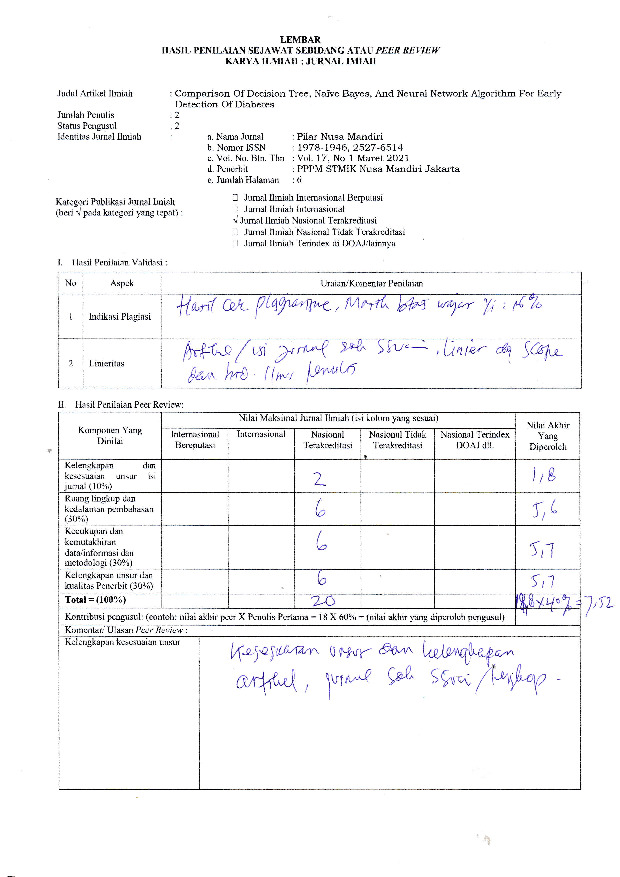
Peer Review
Amalia, H. (2018). Perbandingan Metode Data Mining SVM Dan NN Untuk Klasifikasi Penyakit Ginjal Kronis. Jurnal PILAR Nusa Mandiri, 14(1), 1–6. Retrieved from http://ejournal.nusamandiri.ac.id/index.php/pilar/article/view/80
Annisa, R. (2019). Analisis Komparasi Algoritma Klasifikasi Data Mining Untuk Prediksi Penderita Penyakit Jantung. Jurnal Teknik Informatika Kaputama (JTIK), 3(1), 22–28. Retrieved from https://jurnal.kaputama.ac.id/index.php/JTI
K/article/view/141/156
Apriliah, W., Kurniawan, I., Baydhowi, M., & Haryati, T. (2021). Prediksi Kemungkinan Diabetes pada Tahap Awal Menggunakan Algoritma Klasifikasi Random Forest. Sistemasi: Jurnal Sistem Informasi, 10(1), 163–171. https://doi.org/10.32520/stmsi.v10i1.1129
Argina, A. M. (2020). Penerapan Metode Klasifikasi K-Nearest Neigbor pada Dataset Penderita Penyakit Diabetes. Indonesian Journal of Data and Science, 1 (2), 29–33. https://doi.org/10.33096/ijodas.v1i2.11
Buani, D. C. P. (2018). Prediksi Penyakit Hepatitis Menggunakan Algoritma Naive Bayes Dengan Seleksi Fitur Algoritma Genetika. Jurnal Evolusi, 6(2), 1–5. Retrieved from ejournal.bsi.ac.id
Efendi, M. S., & Wibawa, H. A. (2018). Prediksi Penyakit Diabetes Menggunakan Algoritma ID3 dengan Pemilihan Atribut Terbaik (Diabetes Prediction using ID3 Algorithm with Best Attribute Selection). JUITA, VI(1), 29–35.
Handayani, P., Nurlelah, E., Raharjo, M., & Ramdani, P. M. (2019). Prediksi Penyakit Liver Dengan Menggunakan Metode Decision Tree dan Neural Network. CESS (Journal of Computer Engineering System and Science), 4(1), 55–59.
https://doi.org/10.24114/cess.v4i1.11528
Handayanna, F., Rinawati, Arisawati, E., & Dewi, L. S. (2017). Prediksi Penyakit Diabetes Menggunakan Naive Bayes dengan Optimasi Parameter Menggunakan Algoritma Genetika. KNiST (Konferensi Nasional Ilmu Sosial & Teknologi), 71–76.
Nugraha, F. S., Shidiq, M. J., & Rahayu, S. (2019).
Kiriman Terbaru
23 Oct 2026

23 Oct 2026

23 Oct 2026

23 Oct 2026

23 Oct 2026