The objectives of this study are to identify, classify, and analyze an error analysis of mother tongue influence on grammatical errors in English as Foreign Language students’ paper. The study conducted in Department of English the Academy of Foreign Language BSI Jakarta Indonesia. The students were enrolled in a writing course in the third semester of the academic year 2017-2018. The method used was descriptive method through content analysis in students’ papers. The result of this study showed, it was revealed that the mother tongue influence on grammar errors was the most common type of errors. The most common and salient mother tongue influence which were found in the students' paper are Subject-Verb agreement, verb tense and form, word order, plurality, and Passive voice. The study also showed that the errors occurred in the technical understanding of the target language. Furthermore, students need more reinforcement and development in understanding of Subject-Verb agreement.
Sampul Jurnal
Similarity Check

Dewan Redaksi
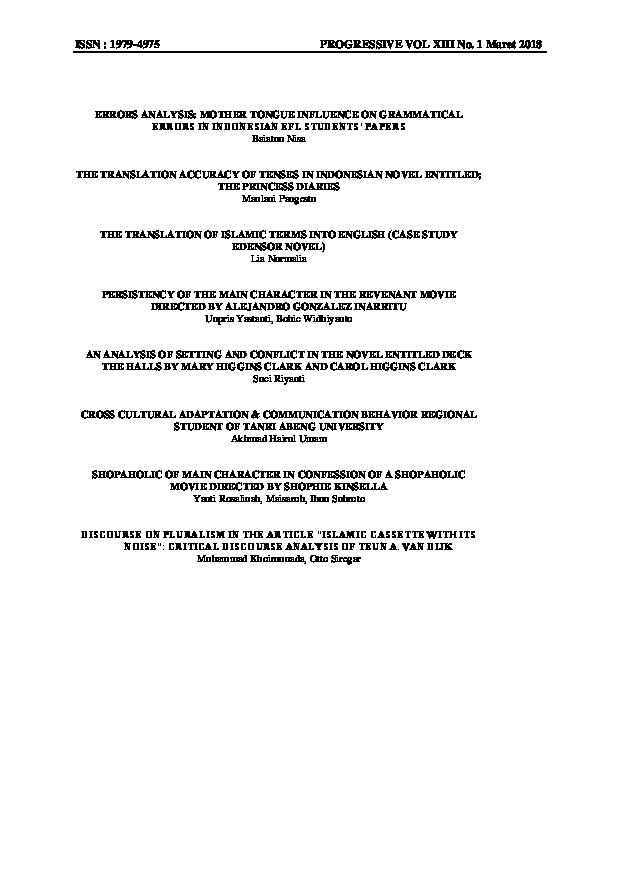
Daftar Isi
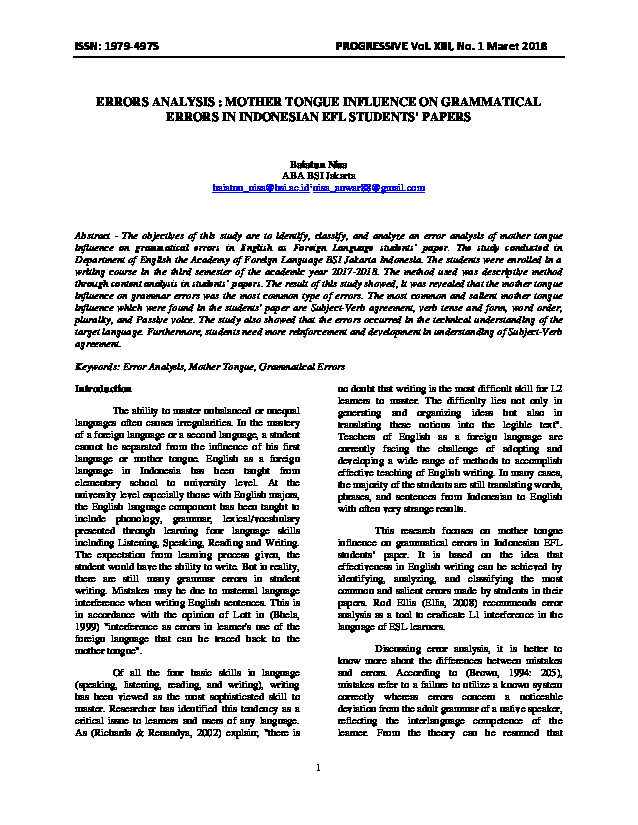
Artikel Lengkap
Bhela, B. (1999). Native Language Interference in Learning a Second Language. Australia; International Educational Journal, vol 1(1).
Brown, H. D. (1994). Principles of Language Learning and Teaching. Eaglewood Cliffs, N.J: Prentice-Hall.
Corder. (2016). Error Analysis. Singapore: Longman.
Ellis, R. (2008). The Study of Second Language Acquisition (2nd ed.). Oxford: Oxford University Press.
Nordquist, R. (2017). the Meaning of the Term Mother Tongue. Retrieved April 14, 2018, from https://www.thoughtco.com/mother-tongue-language-1691408
Richards, J. . (1974). Error Analysis and Second Language Strategies. (J. H Scumann and N. Stenson, Ed.). Rowley Mass: Newbury House.
Richards, J. ., & Renandya, W. (2002). Methodology in Language Teaching. Cambridge: Cambridge University Press.